


Look, if you source COB LED strip connectors, you know the headache. Client wants no flicker. But the samples? Junk. I’ve been in this Shenzhen game for years, and I see buyers make the same mistake constantly.
They fight for weeks over the strip price (lumens, CRI, blah blah), then just grab whatever cheap connector is lying around.
Don’t do that. That little plastic piece causes 90% of site failures. Before your next bulk order, read this. Save yourself the headache.
1. LED Strip Connector Types
First, grab a ruler. Is your PCB 8mm or 10mm? If you force a 10mm connector onto an 8mm strip, you’re screwed.
Next, count the pins and the widths. This confuses everyone:
1) LED strip connector 2 pin 5mm
— for single color LED strips

2) LED strip connector 2 pin 8mm
— for single color LED strips

3) 10mm COB LED Strip Connector 2 pin
— for single color LED strips

4) 5 pin LED Strip Connector
— for RGB COB LED strips

5) 6 pin LED Strip Connector
— for RGB COB LED strips

6) LED Strip Connector 3 pin
— for CCT COB LED strips
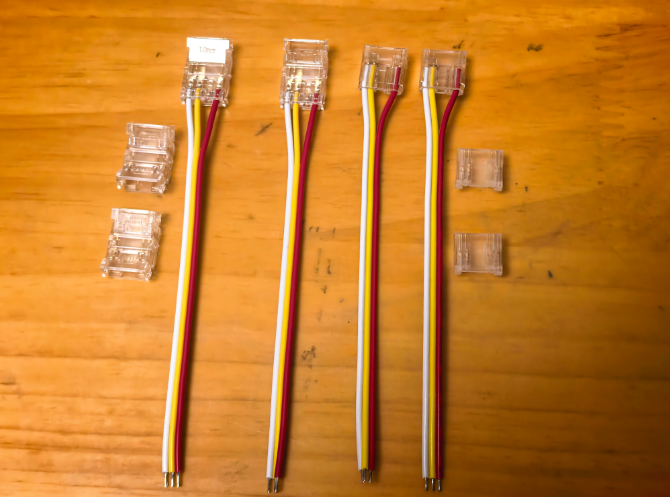
We offer diverse COB LED strip connector types, including 90 degree LED strip connector, RGB LED strip connector.
2. Current Rating: Watch Out for Cheap Heat
Truth bomb: Cheap connectors use thin copper. A standard 2-pin rated at 4A is okay for short, dim strips.
But high-density 24V COB strips pull serious amps. Use a weak connector, and the plastic will literally melt.
My advice? Do the math. Calculate your max current, then spec the connector 30% higher. Cheap insurance. Running long lines? Demand 18AWG or 20AWG wire inside. Don’t argue.
3. Contacts: Gold vs. Tin
You can’t check every piece in a big order, so listen up.
Tin-plated copper? It’ll oxidize fast. Resistance goes up. Problems start.
Gold-plated phosphor bronze? That’s the stuff. Costs more, but for commercial jobs, it means no callbacks. Pay me now, or pay me later.
And test the clip. If it doesn’t “snap” hard, reject it. Loose = Flicker. Simple.
4. Tool-Free Isn’t Always Fast
The promise of solderless connectors is speed. If your guy needs pliers or a screwdriver, you’re bleeding money on labor.
Find “flip-top” or “lever” types. Good one? Takes 30 seconds: Open, Insert, Snap. Done.
5. IP Ratings Are a Lie (Sometimes)
Slapping an IP67 connector on an IP65 strip doesn’t make the *joint* waterproof. That seam is the weak spot.
Bathrooms/Outdoors: Get connectors with silicone gaskets. Period.
Underwater (IP68): Be honest. Skip solderless. Just solder it and use heat shrink. That’s the only way to be sure.
6. Shape Up: L-Shape vs. U-Type
Help your installers out.
Straight: Basic run.
L-Shaped (90°): For tight cabinet corners. Don’t skip these.
T-Shaped: For splitting lines.
Gapless U-Type: Big in high-end arch lighting right now. Looks seamless. Designers love this stuff. Stock it.
7. Stop Chasing Pennies (TCO)
Let’s talk real money. Cheap connector saves you $0.05.
Failure inside a dropped ceiling? Repair bill is $50+.
For anything hard to reach, quality beats price. Every. Single. Time.
8. Check Your Factory (Not Just the Paper)
Product isn’t everything. The partner matters.
Certs: CE, RoHS, LVD. Need ’em for Europe. No excuse.
Samples: Test the connector with your actual COB strip. Not some random one.
Lead Time: Late connectors = Project shutdown. Make sure their schedule matches yours.
FAQ (Quick Answers)
Q: Can I use a regular SMD connector for COB?
A: Hell no. Width and pin space are different. It won’t work right.
Q: Why is my COB strip flickering with new connectors?
A: Usually bad current rating (overheating) or loose pins. Check voltage (12V/24V) and wattage.
Q: 18AWG vs. 20AWG? What’s the diff?
A: 18AWG is thicker. Better for long runs (5m+) to avoid voltage drop. 20AWG is fine for short runs.
Stop treating COB LED strip connectors like an afterthought. Focus on fit, power, and build quality. Less returns, better rep.
Need connectors that actually work? Hit up our engineering team at info@lemonledstrip.com. We’ll check compatibility for free.

